Josef Albers Art Josef Albers Homage to the Square Ascending
'Look! The colour orange is at the door and says to the xanthous, "You go first." But the yellow is too polite and says, "No, you go first." They are like good friends and their conversation is very charming.' —Josef AlbersEvincing luminous bands of yellow and ochre on an intimately scaled, squared surface, Written report for Homage to the Square: Difficult, Softer, Soft Border perfectly encapsulates the exploration of colour, rhythm and spatial movement that divers Josef Albers's iconic Homage to the Foursquare serial. Within a punctilious composition of nestled squares, Albers separates cadmium yellow from introspective maroon, and as one grows more radiant, the other appears increasingly subdued. In their interaction, the chromatic variants become playful and elusive, shifting away from their objective nature and instead forming serendipitous illusions. Painted in 1964, merely 1 year after Albers had published his seminal treatise Interaction of Colour, Written report for Homage to the Foursquare: Hard, Softer, Soft Border demonstrates the technical mastery of color and form that the creative person had attained with his titular serial, more than than a decade after first embarking on it. 'Seeing several of these paintings next to each other makes it obvious that each painting is an instrumentation in its own,' the creative person explained. 'This means that they are all of unlike palettes, and, therefore, then to speak, of unlike climates. Option of the colours used, too as their order, is aimed at an interaction'.one
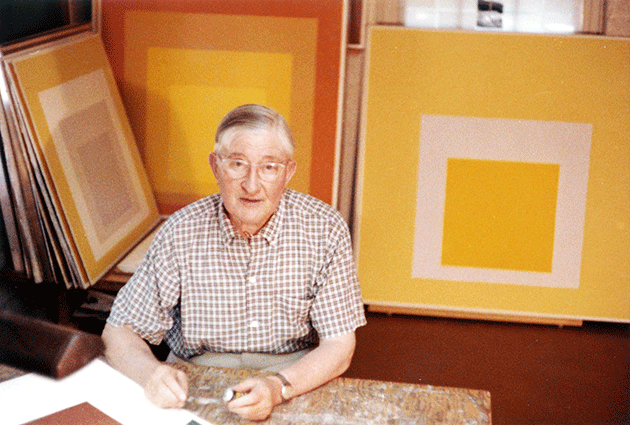
'The square is not a goal in itself; rather, it above all gives a grade to colour and to the genuinely painterly organisation of color.' —Heinz LiesbrockSince commencing the series in 1950, Albers painted his Homages to the Square compositions every mean solar day every bit a kind of meditative exercise, continuously pursuing his investigations into colour theory until the end of his life. Seeking to minimise testify of the creative person's hand, Albers employed unmixed pigment directly from the tube, applying it with a palette pocketknife in brusque and precise strokes. As with all of his Homage to the Squares, Albers carefully recorded the technical details of his composition's execution, documenting the types of paint used on the opposite of the Masonite panel. Alongside his minimal and systematic awarding of colour, this methodical codification clearly reflected a conceptual agreement of painting that anticipated much of fine art making in the mid-1960s, when painting was stripped of its transcendental aims. Notably, the works' repeated square format is redolent of such creative precedents as Kazimir Malevich'due south Blackness Foursquare of 1915, and concurrent creations including Frank Stella'southward 1960s concentric squares. The two artists' seminal contributions differed profoundly in creative and conceptual intention, still converged in the appreciation of the graphic backdrop enabled by the foursquare.
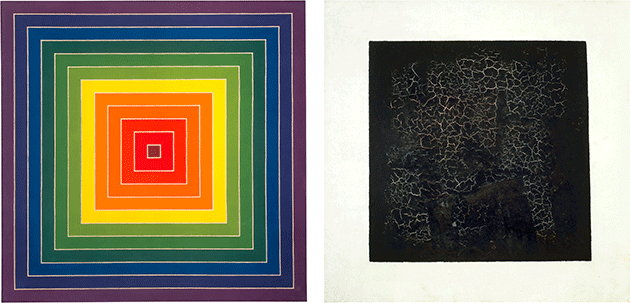
Right: Kazimir Malevich, Black Square, C20th, oil on sheet, Tretyakov Gallery, Moscow, Image: Bridgeman Images.
'When you really understand that each color is changed by a changed environment, you eventually observe that you have learned well-nigh life as well as about color.'
—Josef AlbersAlbers' dedication to investigating the backdrop of colour hailed him one of the foremost theorists of art in the twentieth century. Bolstered by his teaching experience at the Bauhaus, Blackness Mount College and Yale Academy, Albers was acutely sensitive to the subject of colour — its variations, its emotional potential, its reliance on individuated perceptions. For him, tone and hue, saturation and brightness became animated through a vivid synaesthesia which personified every shade: 'Look!' he described. 'The colour orange is at the door and says to the xanthous, "You go first." Just the yellowish is also polite and says, "No, you lot go first." They are like proficient friends and their conversation is very mannerly'.2 In Study for Homage to the Square: Hard, Softer, Soft Border, Albers stages this charismatic encounter, listening attentively to the entrancing, mysterious conversations of colour. The methodical application of paint only emphasises the innate sense of camaraderie that exists between the chromes, exuding a straightforward, effortless symbiosis that is immediately striking and touching to the viewer.
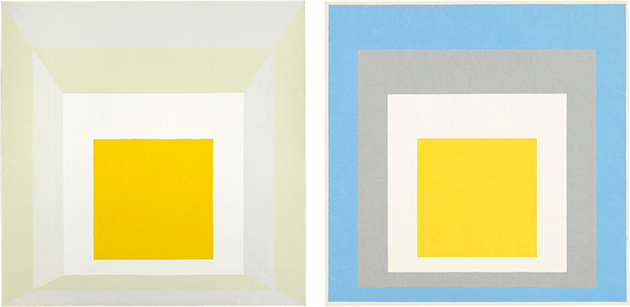
Correct: Josef Albers, Homage to the Foursquare: "Ascending", 1953, oil on composition board, Whitney Museum of American Fine art, New York. Image: © 2021. Digital image Whitney Museum of American Art / Licensed by Scala. © The Josef and Anni Albers Foundation / DACS 2021.
For Albers, the purpose of the integration of colour was to evoke different moods and visual effects through the contrasting combination of seemingly overlapping squares – often reflected in his titles, which he regarded equally poetic language. Written report for Homage to the Square: Hard, Softer, Soft Border beautifully exemplifies this idiosyncratic characteristic, only also, chiefly testifies to Albers' particular affection for the colour yellow (the artist one time stated he 'was for years in the xanthous period').three Deeply influenced past Goethe's 1810 Theory of Colour, Albers viewed the luminous hue as caring, curing and uplifting. Indeed, Study for Homage to the Square: Hard, Softer, Soft Border echoes Goethe's words that 'a strong yellow…has a magnificent and noble effect…The eye is gladdened, the heart expands, the feelings are cheered, an firsthand warmth seems to waft toward us'.4
Master of Geometric shows archival footage and imagery of Josef Albers's life and piece of work.
one Josef Albers, quoted in Josef Albers, exh. true cat., The Mayor Gallery, London, 1989, p. 31.
ii Josef Albers, quoted in Frederick A. Horowitz and Brenda Danilowitz, Josef Albers: To Open Eyes, New York, 2006, p. 199.
3 Josef Albers, quoted in 'Oral history interview with Josef Albers', June 22 - July v, 1968, Smithsonian Archives of American Art, Washington, D.C., online.
4 Goethe…
-
The Pollock Gallery Ltd., Toronto
Individual Drove (caused from the above in 1972)
Christie'south, New York, xvi May 2013, lot 328
Caused at the in a higher place sale by the present possessor -
Museo d'Arte Contemporanea di Roma; Miami, The Patricia & Phillip Frost Art Museum, Florida International Academy, Global Substitution: Geometric abstraction since 1950, seven May 2014 - iv January 2015
Museo de Arte Contemporáneo Buenos Aires, Obsesión geométrica: escuela americana 1965-2015, 17 October 2015 - 13 March 2016, p. 114 (illustrated)
New York, El Museo del Barrio, The Illusive Eye, 3 February - 21 May 2016 -
German language-American • 1888 - 1976
Josef Albers was a German language-American artist and educator, best known for his series Homage to the Square. His rigid, geometric works focus on the interplay of color and shape, and Albers is considered ane of the fathers of both Minimalism and Conceptual Art.
Albers was born in Bottrop, Deutschland, and relocated to Munich in 1919 to report at the metropolis'due south University of Fine Arts. Albers began his career equally an educator at the famous Bauhaus in 1922, first equally a stained glass instructor so as a full professor in 1925. Working at the Bauhaus brought Albers into contact with many other famous artists of the period, including Kandinsky and Klee. When the Nazis forced the Bauhaus' closure in 1933, Albers left Germany and settled permanently in the United States.
For ten years, Albers (and his married woman, fellow artist Anni Albers) taught at Black Mountain College, a progressive school in North Carolina. Between his time there and later at Yale Academy, Albers taught a number of artists who would later become quite famous, including Robert Rauschenberg, Cy Twombly, Eva Hesse, Ruth Asawa and Richard Anuszkiewicz.
0 Response to "Josef Albers Art Josef Albers Homage to the Square Ascending"
Post a Comment